|
| __host__ __device__ | PolymorphicArray4 (Array4< T > const &a) |
| __host__ __device__ T & | operator() (int i, int j, int k) const noexcept |
| __host__ __device__ T::reference_type | operator() (int i, int j, int k, int n) const noexcept |
| __host__ __device__ T & | operator() (int i, int j, int k, int n) const noexcept |
| __host__ __device__ constexpr | ArrayND () noexcept |
| | Default-construct an empty accessor.
|
| __host__ __device__ constexpr | ArrayND (ArrayND< std::remove_const_t< T >, N, last_dim_component > const &rhs) noexcept |
| | Construct a const accessor from a non-const accessor.
|
| __host__ __device__ | ArrayND (T *a_p, BoxND< N > const &box) noexcept |
| | Constructor using a BoxND.
|
| __host__ __device__ | ArrayND (T *a_p, BoxND< M > const &box, int ncomp) noexcept |
| | Constructor using a BoxND and the number of components.
|
| __host__ __device__ constexpr | ArrayND (T *a_p, IntVectND< N > const &a_begin, IntVectND< N > const &a_end) noexcept |
| | IntVectND<N> constructor.
|
| __host__ __device__ constexpr | ArrayND (T *a_p, Dim3 const &a_begin, Dim3 const &a_end, int a_ncomp) noexcept |
| | Constructor for N=4 using Dim3.
|
| __host__ __device__ constexpr | ArrayND (T *a_p, IntVectND< M > const &a_begin, IntVectND< M > const &a_end, int ncomp) noexcept |
| | Reduced dimension constructor with component count.
|
| __host__ __device__ constexpr | ArrayND (ArrayND< U, N, last_dim_component > const &rhs, int start_comp) noexcept |
| | Slicing constructor (Component subset).
|
| __host__ __device__ constexpr | ArrayND (ArrayND< U, N, last_dim_component > const &rhs, int start_comp, int num_comp) noexcept |
| | Slicing constructor (Component subset with count).
|
| __host__ __device__ constexpr | operator bool () const noexcept |
| | Check if the ArrayND pointer is valid.
|
| __host__ __device__ constexpr bool | ok () const noexcept |
| | Check if the ArrayND pointer is valid and bounds are valid.
|
| __host__ __device__ T & | operator() (idx... i) const noexcept |
| | Multi-index operator() for accessing elements.
|
| __host__ __device__ T & | operator() (IntVectND< M > const &iv) const noexcept |
| | Access element by IntVectND.
|
| __host__ __device__ T & | operator() (IntVectND< M > const &iv, int n) const noexcept |
| | Access element by spatial IntVectND and component index.
|
| __host__ __device__ T * | ptr (idx... i) const noexcept |
| | Multi-index ptr() for accessing pointer to element.
|
| __host__ __device__ T * | ptr (IntVectND< M > const &iv) const noexcept |
| | Access pointer by IntVectND.
|
| __host__ __device__ T * | ptr (IntVectND< M > const &iv, int n) const noexcept |
| | Access pointer by spatial IntVectND and component index.
|
| __host__ __device__ constexpr T * | dataPtr () const noexcept |
| | Get raw data pointer.
|
| __host__ __device__ constexpr int | nComp () const noexcept |
| | Get number of components.
|
| __host__ __device__ constexpr std::size_t | size () const noexcept |
| | Total number of elements in the ArrayND's index region.
|
| __host__ __device__ constexpr Long | get_stride () const noexcept |
| | Return the stride (in elements) for dimension d.
|
| __host__ __device__ constexpr bool | contains (idx... i) const noexcept |
| | Test whether an index tuple lies inside the ArrayND bounds.
|
| __host__ __device__ constexpr bool | contains (IntVectND< M > const &iv) const noexcept |
| | Test whether an IntVectND lies inside the ArrayND bounds.
|
| __host__ __device__ constexpr bool | contains (IntVectND< M > const &iv, int n) const noexcept |
| | Test whether a spatial index and component lie inside the bounds.
|
| __host__ __device__ CellData< T > | cellData (int i, int j, int k) const noexcept |
| | Create a single-cell component accessor.
|
| __host__ __device__ constexpr Long | get_offset (IntVectND< M > const &iv) const noexcept |
| | Compute the linear offset (in elements) for an IntVectND.
|
| __host__ __device__ constexpr Long | get_offset (IntVectND< M > const &iv, int n) const noexcept |
| | Compute the linear offset (in elements) for an IntVectND and component index.
|
| __host__ __device__ T & | operator() (int i, int j, int k) const noexcept |
| | Access Array4 element using three integer spatial indices.
|
| __host__ __device__ T & | operator() (int i, int j, int k, int n) const noexcept |
| | Access Array4 element using three integer spatial indices and component index.
|
| __host__ __device__ T & | operator() (IntVectND< M > const &iv) const noexcept |
| | Access Array4 element by spatial indices in IntVectND.
|
| __host__ __device__ T & | operator() (IntVectND< M > const &iv, int n) const noexcept |
| | Access Array4 element by spatial indices in IntVectND and component index.
|
| __host__ __device__ T & | operator() (Dim3 const &cell) const noexcept |
| | Access Array4 element by spatial indices in Dim3.
|
| __host__ __device__ T & | operator() (Dim3 const &cell, int n) const noexcept |
| | Access Array4 element by spatial indices in Dim3 and component index.
|
| __host__ __device__ T * | ptr (int i, int j, int k) const noexcept |
| | Return the pointer to an element.
|
| __host__ __device__ T * | ptr (int i, int j, int k, int n) const noexcept |
| | Return the pointer to an element.
|
| __host__ __device__ T * | ptr (IntVectND< M > const &iv) const noexcept |
| | Return the pointer to an element.
|
| __host__ __device__ T * | ptr (IntVectND< M > const &iv, int n) const noexcept |
| | Return the pointer to an element.
|
| __host__ __device__ T * | ptr (Dim3 const &cell) const noexcept |
| | Return the pointer to an element.
|
| __host__ __device__ T * | ptr (Dim3 const &cell, int n) const noexcept |
| | Return the pointer to an element.
|
| __host__ __device__ bool | contains (int i, int j, int k) const noexcept |
| | Test whether the spatial indices are inside the Array4 bounds.
|
| __host__ __device__ bool | contains (IntVectND< M > const &iv) const noexcept |
| | Test whether the spatial indices are inside the Array4 bounds.
|
| __host__ __device__ bool | contains (Dim3 const &cell) const noexcept |
| | Test whether the spatial indices are inside the Array4 bounds.
|
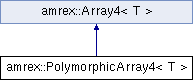
template<typename T>
class amrex::PolymorphicArray4< T >
Array4 subclass that provides uniform
Dispatches operator()(i,j,k,n) to the appropriate access pattern depending on whether T is a multi-component value type (AoS) or a scalar type (SoA). SoA refers to a multi-component BaseFab; AoS refers to a single-component BaseFab whose element type is a multi-component GpuArray.
- Template Parameters
-

 1.15.0